Education

Empower your educational journey with Examples.com comprehensive resources. Our platform offers a wide range of free educational examples and in-depth guides, perfect for students, teachers, and lifelong learners. These expertly designed resources, easily editable and printable, cover various educational topics and methodologies. Learn to enhance your study techniques, teaching strategies, and academic research skills. Our practical tips and how-tos provide valuable insights for effective learning and teaching experiences in today’s diverse educational landscape.

Education is the cornerstone of personal and societal development, empowering individuals to acquire knowledge, skills, values, and habits that shape their growth and contributions to the world. It transcends traditional classrooms, embracing diverse methods and tools to meet the unique needs of learners while fostering curiosity, critical thinking, and innovation. As a powerful driver of equality, cultural understanding, and global progress, education plays a vital role in addressing challenges and unlocking potential. From early learning to advanced studies, education is a lifelong journey that builds the foundation for a brighter, more informed future.

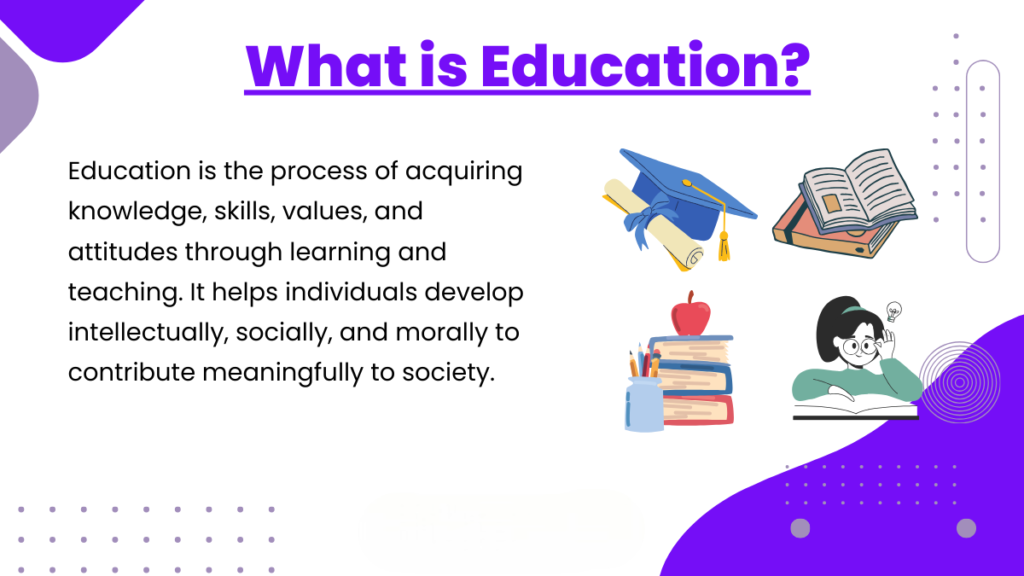
What is Education?

Education is the process of acquiring knowledge, skills, values, beliefs, and habits that enable individuals to grow personally, socially, and professionally. It encompasses formal learning in schools and universities, informal learning through life experiences, and non-formal education through community programs and self-directed exploration. Education fosters critical thinking, creativity, and problem-solving while shaping character, building confidence, and promoting societal progress. It is a lifelong journey that empowers individuals to adapt to change, pursue their passions, and contribute meaningfully to the world.

Examples of Education

Primary schoolCooking at homeGraphic design courses
Learning from familyEnvironmental campaignsBusiness schools
WorkshopsInternational schoolsNeighborhood initiatives
UniversityReading booksFilm-making classes
Travel experiencesLeadership trainingMusic conservatories
High schoolPublic schoolsScience academies
Peer learningListening to podcastsLanguage schools
WebinarsCareer counselingStory writing
Vocational trainingSpecial education programsScience fairs
ApprenticeshipsWatching documentariesSports academies
Community classesFinancial literacy workshopsLocal history tours
STEM educationParticipating in forumsCultural heritage programs
VolunteeringSoft skills trainingCoding competitions
First aid trainingAttending festivalsCommunity theater
MBA programSports coachingRobotics clubs
Self-taught skillsTime management seminarsAstronomy nights
Dance lessonsReligious studiesPublic art projects
Doctoral studiesStress management programsLocal business forums
Mentorship programsArt appreciationEducational internships
Art classesSelf-defense classesPrimary school
Technical certificationsMeditation sessionsCooking at home
Hobbies and craftsSocial media trainingGraphic design courses
Coding bootcampsPersonal branding workshopsBusiness schools
Online degreesProject management trainingNeighborhood initiatives
Life coachingFilm-making classesMusic conservatories
Photography workshopsChess clubsScience academies
Diploma coursesSports clinicsLanguage schools
StorytellingNature walksStory writing
Language learning appsLearning from natureScience fairs
Teacher trainingSkill-sharing workshopsSports academies
Learning from eldersRobotics clubsLocal history tours
Entrepreneurship trainingAstronomy nightsCultural heritage programs
Professional workshopsPublic art projectsCoding competitions
Museum visitsLocal business forumsCommunity theater
Parenting classesMedical simulationsRobotics clubs
DIY projectsEnvironmental campaignsAstronomy nights
Health awareness seminarsInternational schoolsPublic art projects
Private schoolsReading booksLocal business forums
VR learningHackathonsClimate campaigns
Historical reenactmentsOpen-source trainingOpen-source training

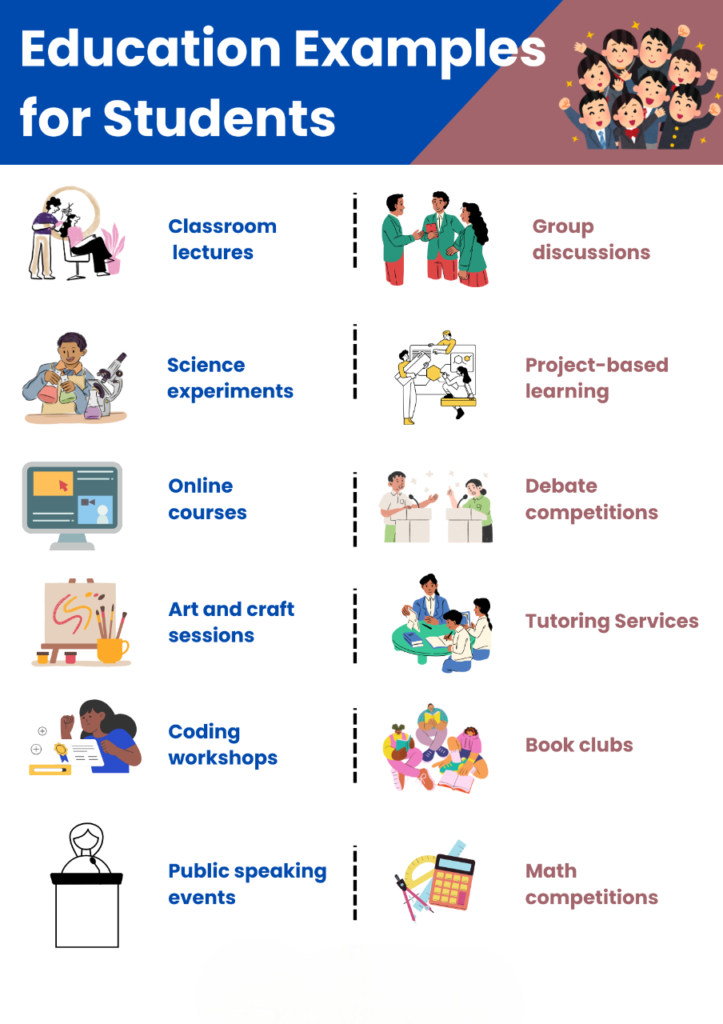
Education Examples for Students

  • Classroom lectures
  • Group discussions
  • Science experiments
  • Project-based learning
  • Online courses
  • Interactive whiteboards
  • Debate competitions
  • Peer tutoring
  • Educational games
  • Role-playing activities
  • Art and craft sessions
  • Language labs
  • Coding workshops
  • Field trips
  • STEM projects
  • Book clubs
  • Public speaking events
  • Problem-solving tasks
  • Career counseling sessions
  • Sports and physical education
  • Music and dance classes
  • Math competitions
  • Science fairs
  • History exhibitions
  • Environmental campaigns
  • Mock trials
  • Drama performances
  • Robotics clubs
  • Virtual reality lessons
  • Internship programs

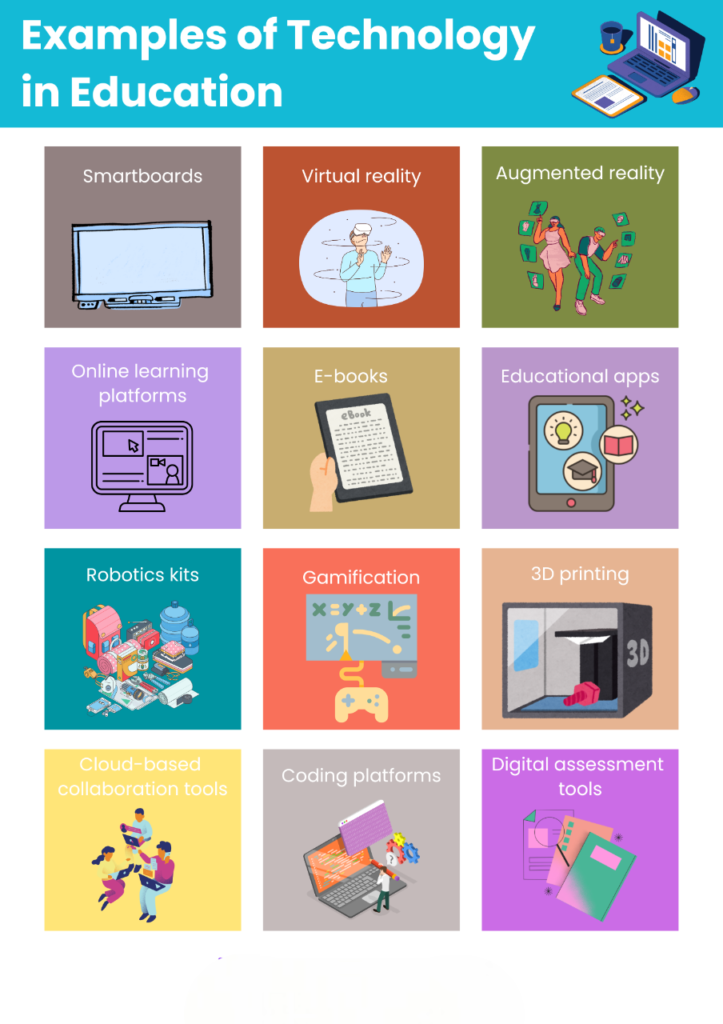
Examples of Technology in Education

  1. Technology in education refers to the integration of digital tools, platforms, and resources to enhance teaching and learning experiences. It has transformed traditional classrooms into dynamic, interactive environments, enabling personalized learning, real-time collaboration, and access to a wealth of information. From virtual classrooms to AI-driven analytics, technology bridges gaps in education, making it more inclusive and efficient.

    1. Smartboards
    2. Learning management systems (LMS)
    3. Virtual reality (VR) for immersive learning
    4. Augmented reality (AR) applications
    5. Online learning platforms (e.g., Coursera, Khan Academy)
    6. E-books and digital libraries
    7. AI-powered tutoring systems
    8. Educational apps (e.g., Duolingo, Quizlet)
    9. Robotics kits for STEM learning
    10. Gamification in education
    11. 3D printing for hands-on projects
    12. Cloud-based collaboration tools (e.g., Google Classroom)
    13. Virtual labs and simulations
    14. Video conferencing for remote learning
    15. Interactive learning games
    16. Adaptive learning software
    17. Coding platforms for kids (e.g., Scratch)
    18. Digital assessment tools
    19. Internet of Things (IoT) devices for smart campuses
    20. Wearable devices for health and learning analytics

    Examples of AI in Education

    AI in education involves the use of artificial intelligence technologies to enhance learning processes, personalize education, and improve administrative efficiency. It enables adaptive learning, automated assessments, and intelligent tutoring systems that cater to individual student needs. By analyzing data and predicting trends, AI empowers educators to make informed decisions and provides students with engaging, customized experiences.

    1. Adaptive learning platforms
    2. AI-powered tutoring systems
    3. Automated grading tools
    4. Personalized learning recommendations
    5. Chatbots for student support
    6. AI-based language learning apps (e.g., Duolingo)
    7. Predictive analytics for student performance
    8. Virtual teaching assistants
    9. Automated attendance systems
    10. AI-driven career guidance tools
    11. Real-time translation for multilingual classrooms
    12. AI-powered content curation
    13. Intelligent plagiarism detection tools
    14. Speech-to-text tools for note-taking
    15. AI in exam proctoring
    16. Gamified learning using AI algorithms
    17. Sentiment analysis for student feedback
    18. Smart curriculum design tools
    19. Virtual reality education enhanced with AI
    20. AI-assisted learning for special needs students

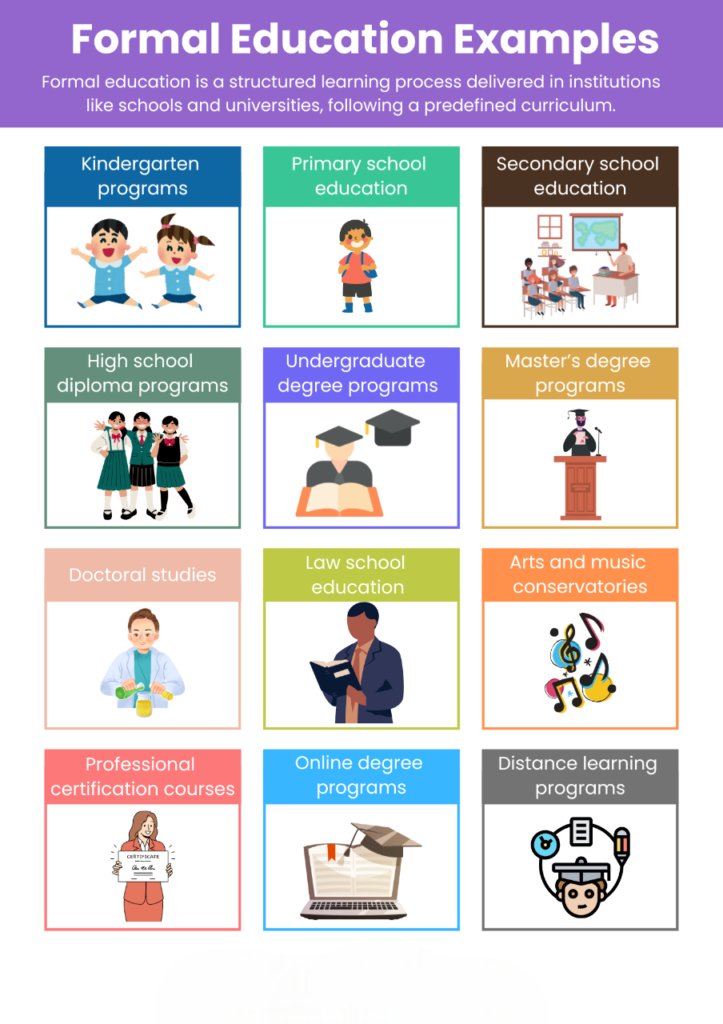
Formal Education Examples

  • Formal education refers to structured and systematic learning that takes place in schools, colleges, universities, and other institutional settings. It typically follows a defined curriculum and leads to recognized certifications or degrees.

    1. Kindergarten programs
    2. Primary school education
    3. Secondary school education
    4. High school diploma programs
    5. Undergraduate degree programs (e.g., B.A., B.Sc.)
    6. Master’s degree programs (e.g., M.A., M.Sc., MBA)
    7. Doctoral studies (Ph.D. or professional doctorates)
    8. Law school education
    9. Medical school training
    10. Vocational training programs
    11. Charter school education
    12. Special education programs
    13. International Baccalaureate (IB) programs
    14. Community college courses
    15. Liberal arts college education
    16. Technical and trade school certifications
    17. STEM-focused education (Science, Technology, Engineering, Math)
    18. Professional certification courses (e.g., CPA, PMP)
    19. Military academy training
    20. Arts and music conservatories
    21. Boarding school education
    22. Religious school programs
    23. Online degree programs
    24. Postgraduate diploma courses
    25. Dual-degree programs
    26. Polytechnic institute training
    27. Adult education diploma programs
    28. Pre-university foundation courses
    29. Distance learning programs
    30. Corporate-sponsored university degrees

    Informal Education Examples

    Informal education refers to learning that occurs outside of a structured curriculum or institutional setting. It is often spontaneous, self-directed, and driven by curiosity or real-life experiences.

    1. Learning from family members
    2. Peer-to-peer learning
    3. Observing and mimicking others
    4. Volunteering experiences
    5. Travel and cultural immersion
    6. Self-directed online research
    7. Reading books or articles
    8. Watching documentaries
    9. Learning through hobbies (e.g., gardening, cooking)
    10. Storytelling and oral traditions
    11. Community workshops and events
    12. Listening to podcasts
    13. Learning from mentors
    14. Participating in local clubs (e.g., chess clubs, art groups)
    15. Attending cultural festivals
    16. Experiential learning through trial and error
    17. Skill-sharing among friends or neighbors
    18. Engaging in public speaking or debates informally
    19. Learning through social media platforms
    20. Observing nature and the environment

    Non Formal Education Examples

    Non-formal education refers to organized educational activities that occur outside the traditional school system. It is often flexible, voluntary, and tailored to specific groups or needs.

    1. Adult literacy programs
    2. Community education workshops
    3. First aid training courses
    4. Yoga and meditation classes
    5. Language learning apps and courses
    6. Coding bootcamps
    7. Financial literacy workshops
    8. Photography or art classes
    9. Leadership training programs
    10. Parenting classes
    11. Health awareness campaigns
    12. Environmental education programs
    13. Entrepreneurship training
    14. Personal development seminars
    15. Public speaking and communication workshops
    16. Self-defense training classes
    17. Project management certification courses
    18. Career counseling sessions
    19. Vocational skills training (e.g., carpentry, tailoring)
    20. Science fairs and exhibitions

    Higher Education Examples

    Higher education refers to post-secondary education provided by colleges, universities, and other institutions that award academic degrees, diplomas, or professional certifications.

    1. Bachelor’s degree programs (e.g., B.A., B.Sc.)
    2. Master’s degree programs (e.g., M.A., M.Sc., MBA)
    3. Doctoral degree programs (e.g., Ph.D., Ed.D.)
    4. Medical school (e.g., M.D., D.O.)
    5. Law school (e.g., J.D., LL.M.)
    6. Business school (e.g., MBA, Executive MBA)
    7. Engineering programs (e.g., B.Eng., M.Eng.)
    8. Liberal arts college education
    9. Community college associate degrees
    10. Postgraduate diploma programs
    11. Online degree programs
    12. Research fellowships
    13. Dual-degree programs (e.g., JD/MBA, MD/PhD)
    14. Technical and trade school certifications
    15. Continuing education courses
    16. Professional schools (e.g., dentistry, pharmacy, veterinary medicine)
    17. Study-abroad programs at universities
    18. Polytechnic education
    19. Certificate programs in specialized fields (e.g., data science, cybersecurity)
    20. Arts and music conservatories

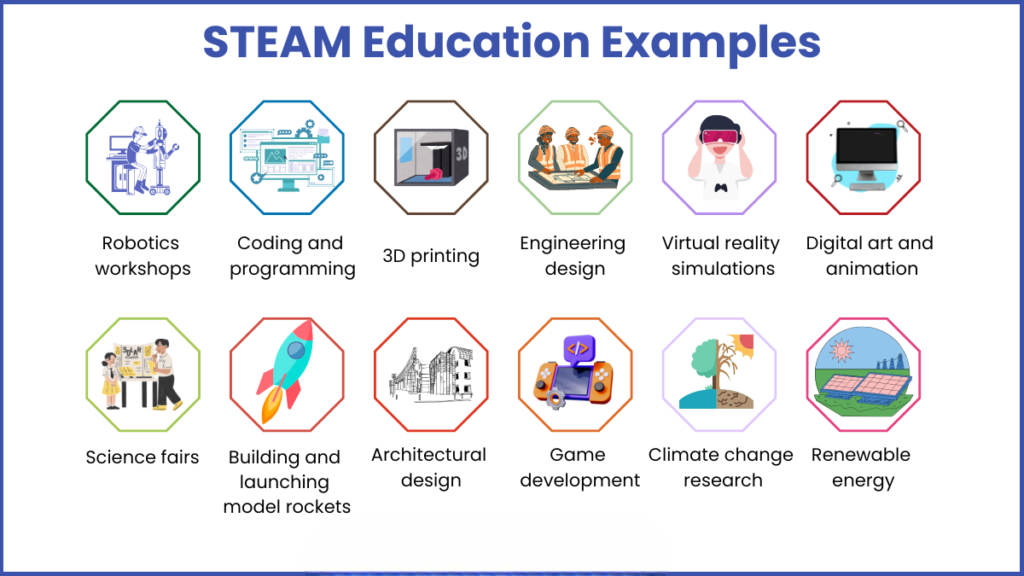
STEAM Education Examples

  • STEAM education integrates Science, Technology, Engineering, Arts, and Mathematics to foster creativity, critical thinking, and problem-solving skills. It emphasizes interdisciplinary learning and hands-on activities.

    1. Robotics workshops
    2. Coding and programming classes
    3. 3D printing projects
    4. Engineering design challenges
    5. Virtual reality simulations for science experiments
    6. Digital art and animation courses
    7. Science fairs showcasing interdisciplinary projects
    8. Building and launching model rockets
    9. Architectural design and modeling
    10. Game development and design
    11. Math-based art projects (e.g., geometric patterns)
    12. Climate change research and model building
    13. Music production using technology
    14. Wearable technology design projects
    15. Renewable energy model construction
    16. Interactive STEM and arts exhibitions
    17. Artificial intelligence project-based learning
    18. Photography classes incorporating physics of light
    19. Data visualization projects blending math and art
    20. Environmental science field studies with creative reporting

    Special Education Examples

    Special education refers to customized teaching approaches and resources designed to meet the unique needs of students with disabilities or exceptionalities. It focuses on providing equal learning opportunities in inclusive or specialized settings.

    1. Individualized Education Programs (IEPs)
    2. Speech and language therapy sessions
    3. Occupational therapy for motor skills development
    4. Behavior intervention plans (BIPs)
    5. Assistive technology for learning (e.g., text-to-speech tools)
    6. Visual schedules for routine management
    7. Social skills training groups
    8. Specialized reading programs for dyslexia
    9. Sensory integration therapy
    10. Adaptive physical education classes
    11. Communication boards or AAC devices
    12. Small group instruction for focused learning
    13. Specialized tutoring for learning disabilities
    14. Sign language classes for hearing impairments
    15. Transition planning for life skills and independence
    16. Classroom modifications (e.g., seating arrangements, extended time)
    17. Braille instruction for visually impaired students
    18. Therapeutic art or music programs
    19. Early intervention programs for developmental delays
    20. Inclusive classrooms with co-teaching models

    Inclusive Education Examples

    Inclusive education ensures that all students, regardless of their abilities, backgrounds, or needs, learn together in the same environment with appropriate support and resources. It promotes diversity, equity, and accessibility in the classroom.

    1. Co-teaching models with general and special education teachers
    2. Universal Design for Learning (UDL) strategies
    3. Peer mentoring programs
    4. Collaborative group activities with diverse learners
    5. Assistive technology tools (e.g., screen readers, speech-to-text)
    6. Modified learning materials for accessibility (e.g., large print, Braille)
    7. Flexible seating arrangements in classrooms
    8. Inclusive sports programs and adaptive physical education
    9. Multilingual support for non-native speakers
    10. Culturally responsive teaching methods
    11. Social skills groups integrated into classrooms
    12. Individualized lesson plans for students with disabilities
    13. Accessible field trips with accommodations for all
    14. Sign language interpreters in mainstream classrooms
    15. Sensory-friendly spaces within schools
    16. Buddy systems to foster peer support
    17. Inclusive school events and extracurricular activities
    18. Accessible online learning platforms
    19. Teacher training on diversity and inclusion
    20. Parental involvement programs to support diverse learners

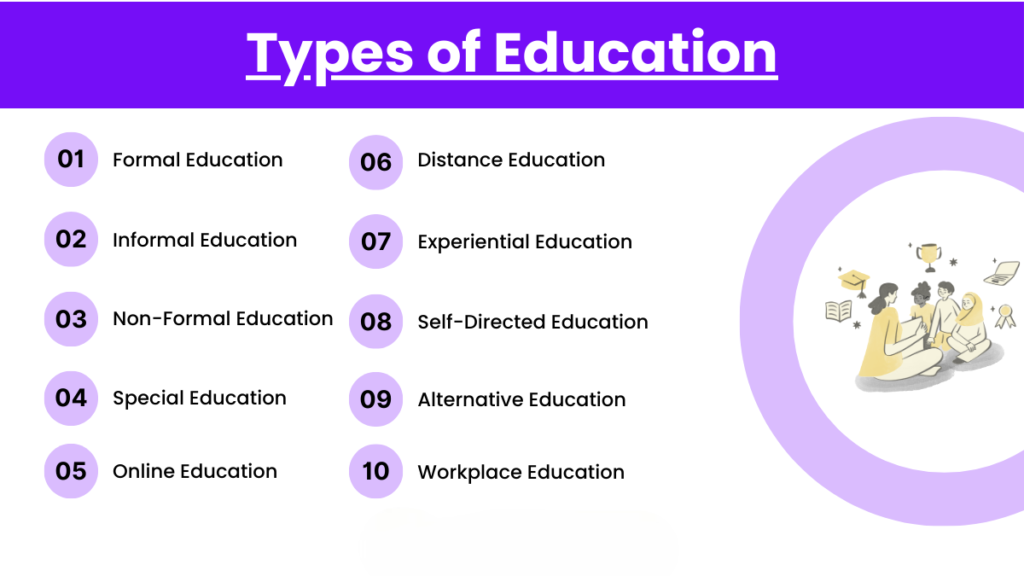
Types of Education

  • 1. Formal Education

    Structured education provided by institutions like schools, colleges, and universities. It follows a fixed curriculum and leads to certification or degrees.

    Examples:

    1. High school diploma programs
    2. University degree courses (e.g., Bachelor’s or Master’s)
    3. Kindergarten to 12th-grade education
    4. Medical school programs
    5. Vocational training in a certified institution

    2. Informal Education

    Learning that occurs naturally through daily activities, experiences, and interactions, without a structured curriculum or institutional setting.

    Examples:

    1. Learning to cook from family members
    2. Gaining knowledge from reading books or blogs
    3. Picking up a language through travel
    4. Watching documentaries on scientific topics
    5. Learning to garden by observing neighbors

    3. Non-Formal Education

    Organized education outside formal institutions, focusing on specific skills or knowledge without rigid structure or certification.

    Examples:

    1. Community-based adult literacy programs
    2. Yoga or fitness classes
    3. Online courses on platforms like Coursera or Udemy
    4. Skill-development workshops (e.g., photography)
    5. Farmer training programs in rural areas

    4. Special Education

    Tailored education designed for individuals with special needs, ensuring inclusivity and addressing specific challenges.

    Examples:

    1. Schools for children with autism
    2. Speech therapy programs
    3. Individualized Education Plans (IEPs) in mainstream schools
    4. Braille education for visually impaired students
    5. Programs for children with ADHD

    5. Online Education

    Learning through digital platforms, allowing flexibility in time and location, often supplemented with multimedia resources.

    Examples:

    1. Online degree programs from accredited universities
    2. Virtual high schools
    3. E-learning platforms like Khan Academy
    4. Certification courses on Data Science
    5. Virtual reality-based simulations for medical training

    6. Distance Education

    Education delivered remotely through correspondence or digital platforms, enabling students to learn without being physically present.

    Examples:

    1. Open University programs
    2. Correspondence courses in creative writing
    3. Video-based training for corporate employees
    4. Remote learning programs during the COVID-19 pandemic
    5. Self-paced study programs in coding

    7. Experiential Education

    Learning through hands-on experiences, focusing on real-world application and active participation.

    Examples:

    1. Internships in corporate sectors
    2. Fieldwork in environmental science courses
    3. Role-playing exercises in leadership workshops
    4. Research projects in a laboratory
    5. Study-abroad cultural immersion programs

    8. Self-Directed Education

    Learning initiated and controlled by the learner, without dependency on formal structures or instructors.

    Examples:

    1. Learning coding through free online tutorials
    2. Reading scientific journals independently
    3. Mastering a musical instrument using YouTube videos
    4. Teaching oneself graphic design using software tutorials
    5. Exploring astronomy with a personal telescope

    9. Alternative Education

    Non-traditional education methods that emphasize creativity, freedom, and individualized approaches to learning.

    Examples:

    1. Montessori schools
    2. Waldorf education system
    3. Homeschooling tailored to a child’s pace
    4. Project-based learning models
    5. Democratic schools where students choose their curriculum

    10. Workplace Education

    Training and development programs provided by employers to enhance skills relevant to specific job roles.

    Examples:

    1. Onboarding training for new hires
    2. Leadership development workshops
    3. Compliance training programs
    4. Technical skill upgrades for software professionals
    5. Safety training for construction workers

    Goals & Purpose of Education

    Goals of Education

    1. To foster critical thinking and problem-solving skills.
    2. To develop a well-rounded individual with social, ethical, and emotional intelligence.
    3. To prepare individuals for meaningful careers and economic independence.
    4. To instill values of citizenship, responsibility, and community engagement.
    5. To promote lifelong learning and adaptability in a changing world.

    Purpose of Education

    1. To empower individuals with knowledge and skills for personal growth.
    2. To contribute to societal progress and innovation.
    3. To reduce inequalities and provide opportunities for all.
    4. To cultivate cultural understanding and global awareness.
    5. To equip individuals to face challenges and make informed decisions.

    How to List Education on Resume

    • Start with the Highest Degree First
      Always list your highest degree or most recent educational achievement at the top.
    • Include Key Details
      Mention the name of the institution, the degree or certification earned, and the dates of attendance or graduation year.Example:
      Bachelor of Science in Computer Science
      University of California, Los Angeles (UCLA), May 2023
    • Optional: Add GPA (if strong)
      Include your GPA if it is 3.5 or higher and you are a recent graduate.Example:
      Bachelor of Business Administration
      University of Texas, Austin, December 2021
      GPA: 3.8/4.0
    • Include Relevant Coursework (if applicable)
      For students or recent graduates without much experience, include relevant coursework, projects, or honors.Example:
      Bachelor of Mechanical Engineering
      Stanford University, June 2022
      Relevant Coursework: Thermodynamics, Fluid Mechanics, Engineering Design
    • Certifications and Professional Training
      Include certifications or additional training if they are relevant to the job.Example:
      Certified Data Analyst
      Coursera, March 2023
    • For Incomplete Education
      If you did not complete a degree, mention your coursework or the duration of attendance.Example:
      Completed Coursework in Marketing
      New York University, 2020–2022
    • For High School Graduates
      If you haven’t pursued higher education, list your high school details.Example:
      High School Diploma
      Lincoln High School, Chicago, June 2019
    • Place in the Right Section
      If you’re a recent graduate, place education at the top of your resume. For experienced professionals, place it below the work experience section.

    Education Issues

    • Access and Equity: Unequal access to quality education due to socio-economic disparities, gender inequality, and lack of infrastructure in rural areas.
    • Quality of Education: Outdated curricula, shortage of qualified teachers, and insufficient focus on critical thinking and practical skills.
    • Funding Challenges: Inadequate government funding and unequal resource distribution among schools, especially in underserved areas.
    • Technological Barriers: Limited access to digital tools and the internet, widening the digital divide and affecting education quality.
    • Student Mental Health: Rising stress, pressure from exams, and lack of counseling services in schools.
    • Dropout Rates: High dropout rates caused by poverty, early marriage, and family responsibilities.
    • Mismatch with Workforce Needs: Education systems failing to align with job market demands, leading to unemployment among graduates.
    • Overemphasis on Standardized Testing: Focus on rote learning over creativity, critical thinking, and holistic development.

THANK YOU

GREAT EDUCATION LEARNING

About Our

Lorem ipsum dolor sit amet, consectetur adipiscing elit. Ut elit tellus, luctus nec ullamcorper mattis.

About School

About Us

Services

Community

Testimonial

Help Centre

Quick Links

Classes

Events

Programs

Become Teacher

Contact Us

© 2023 Created with Royal Elementor Addons