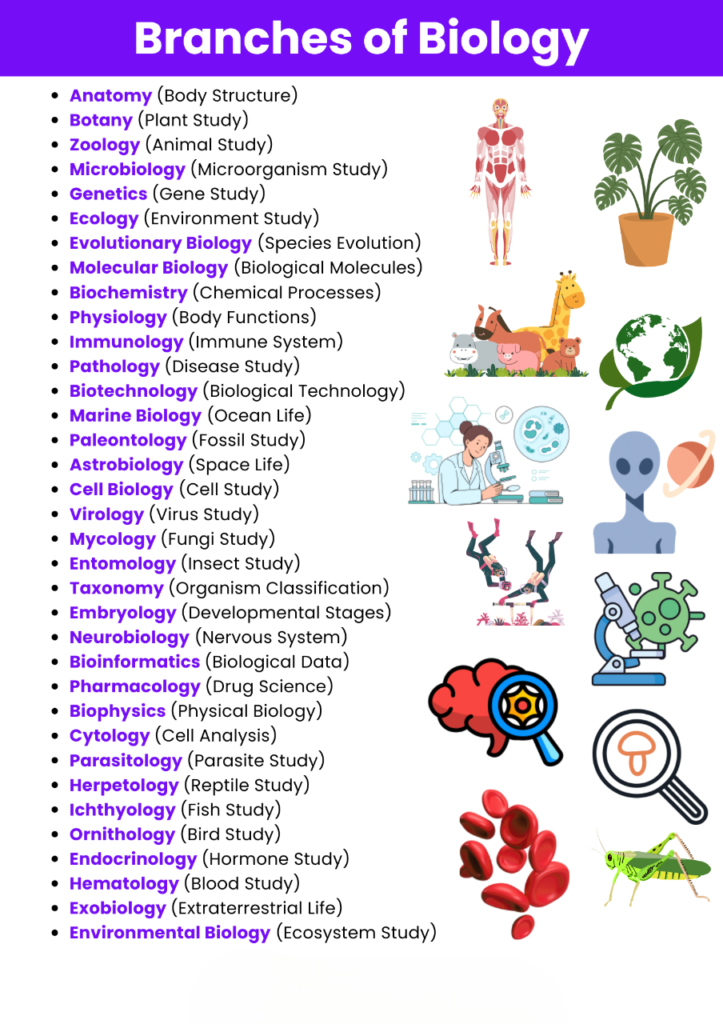
Biology is a vast and diverse field of science that studies life and living organisms. It is divided into several specialized branches, each focusing on a particular aspect of life. Below are the main branches of biology:
1. Anatomy
The study of the structure and organization of organisms, focusing on the internal and external parts of the body.
2. Botany
The study of plants, including their structure, function, growth, reproduction, and classification.
3. Zoology
The study of animals, covering their behavior, anatomy, physiology, evolution, and ecological roles.
4. Microbiology
The study of microorganisms such as bacteria, viruses, fungi, and protists, including their role in ecosystems and human health.
5. Genetics
The study of genes, heredity, and genetic variation in living organisms, exploring how traits are passed from one generation to the next.
6. Molecular Biology
The study of biological molecules and their interactions, focusing on DNA, RNA, proteins, and other macromolecules.
7. Ecology
The study of organisms’ relationships with each other and their environments, including ecosystems, populations, and conservation.
8. Evolutionary Biology
The study of the origins and changes in the diversity of life over time through evolution and natural selection.
9. Biochemistry
The study of the chemical processes and substances occurring within living organisms.
10. Physiology
The study of the functions and mechanisms in living systems, such as respiration, digestion, and reproduction.
11. Immunology
The study of the immune system, its components, and how organisms defend themselves against diseases and pathogens.
12. Pathology
The study of diseases, their causes, processes, development, and effects on the body.
13. Biotechnology
The application of biology to develop technologies and products that improve health, agriculture, and industry.
14. Marine Biology
The study of organisms living in oceans, seas, and other marine environments.
15. Entomology
The study of insects, including their behavior, classification, and ecological roles.
16. Virology
The study of viruses and how they infect and interact with host organisms.
17. Paleontology
The study of fossils and ancient life forms to understand the history of life on Earth.
18. Cell Biology
The study of cells, their structure, function, and processes, as the basic unit of life.
19. Biotechnology
The application of biology to create products and processes for improving life, often involving genetic engineering and microbiology.
20. Astrobiology
The study of life in the universe, including the search for extraterrestrial life and the conditions necessary for life to exist.
History of Biology
The history of biology spans centuries, reflecting humanity’s curiosity about life and its processes. It began with ancient civilizations observing and categorizing plants and animals and evolved into a structured scientific discipline over time. Below is a brief overview of its development:
1. Ancient Period
- Early Observations: Early humans studied plants and animals for survival, focusing on agriculture, hunting, and medicine.
- Egypt and Mesopotamia: Ancient Egyptians documented medical practices and anatomy, while Mesopotamians recorded agricultural techniques.
- Greek Contributions: Philosophers like Aristotle (384–322 BCE) laid the foundations of biology by classifying animals and studying their anatomy and behavior. Hippocrates is credited with establishing medicine as a science.
2. Medieval Period
- Islamic Golden Age: Scholars like Al-Jahiz and Avicenna (Ibn Sina) advanced biological knowledge by studying animal behavior, medicine, and physiology.
- European Decline: During the Dark Ages in Europe, biological progress slowed, but monastic scholars preserved Greek and Roman texts.
3. Renaissance and Early Modern Period (14th–17th Century)
- Rediscovery of Knowledge: Classical texts were revived, leading to advancements in anatomy and physiology.
- Notable Figures:
- Leonardo da Vinci: Made detailed anatomical drawings through dissections.
- Andreas Vesalius: Published “De humani corporis fabrica,” revolutionizing human anatomy.
- William Harvey: Discovered blood circulation.
4. Enlightenment and Scientific Revolution (17th–18th Century)
- Microscope Invention: Robert Hooke and Anton van Leeuwenhoek used microscopes to discover cells and microorganisms.
- Classification Systems: Carl Linnaeus developed a systematic taxonomy to classify organisms, introducing binomial nomenclature.
5. 19th Century: The Birth of Modern Biology
- Evolutionary Theory: Charles Darwin published On the Origin of Species (1859), introducing natural selection as a mechanism for evolution.
- Cell Theory: Matthias Schleiden and Theodor Schwann established that all living organisms are made of cells.
- Mendelian Genetics: Gregor Mendel conducted experiments on pea plants, laying the foundation for genetics.
- Germ Theory: Louis Pasteur and Robert Koch demonstrated that microorganisms cause diseases.
6. 20th Century: The Molecular Era
- DNA Discovery: Watson and Crick, along with Rosalind Franklin, discovered the double-helix structure of DNA in 1953.
- Advances in Genetics: The study of DNA and RNA led to the field of molecular biology.
- Ecology and Conservation: Greater awareness of ecosystems, biodiversity, and conservation emerged during this period.
7. 21st Century: Biotechnology and Genomics
- Human Genome Project: Completed in 2003, it mapped all human genes, revolutionizing genetics and medicine.
- CRISPR Technology: A powerful tool for editing genes, offering potential cures for genetic disorders.
- Synthetic Biology: Scientists began engineering organisms to produce medicines, fuels, and other resources.
- Global Challenges: Biology addresses issues like climate change, pandemics, and food security through innovative solutions.
The history of biology is a testament to humanity’s evolving understanding of life, driven by curiosity and technological advances. From ancient observations to modern genetic engineering, biology continues to shape the future of science, medicine, and the environment.
Basic Concepts of Biology
1. Cell Theory
- All living organisms are composed of one or more cells.
- The cell is the basic unit of life.
- All cells arise from pre-existing cells.
Cells can be prokaryotic (without a nucleus, e.g., bacteria) or eukaryotic (with a nucleus, e.g., plants and animals).
2. Genetics and Heredity
- DNA as Genetic Material: DNA (Deoxyribonucleic Acid) carries the genetic instructions for development, functioning, and reproduction.
- Genes and Chromosomes: Genes are segments of DNA that code for proteins, while chromosomes are organized structures of DNA.
- Inheritance: Traits are passed from parents to offspring through genetic material.
3. Evolution and Natural Selection
- Evolution: The process by which species change over time due to genetic variation and environmental pressures.
- Natural Selection: Proposed by Charles Darwin, it is the mechanism where individuals with favorable traits are more likely to survive and reproduce.
4. Homeostasis
- Maintaining Internal Balance: Organisms regulate internal conditions (like temperature, pH, and water balance) to sustain life, despite external changes.
- Examples: Sweating to cool down or kidneys regulating water balance.
5. Metabolism
- Chemical Reactions for Life: Metabolism encompasses all chemical reactions in the body, including catabolism (breaking down molecules for energy) and anabolism (building complex molecules).
- Energy Production: Cellular respiration converts glucose into ATP, the energy currency of cells.
6. Reproduction
- Asexual Reproduction: Involves a single organism producing offspring genetically identical to itself (e.g., binary fission in bacteria).
- Sexual Reproduction: Involves the combination of genetic material from two parents, resulting in genetically diverse offspring (e.g., humans, plants).
7. Ecology and Interdependence
- Interactions with Environment: Organisms interact with each other and their environment, forming ecosystems with complex food webs and energy flows.
- Symbiosis: Includes mutualism (both benefit), commensalism (one benefits, the other unaffected), and parasitism (one benefits, the other harmed).
8. Adaptation
- Traits for Survival: Adaptations are inherited traits that enhance an organism’s ability to survive and reproduce in specific environments.
- Examples: Camouflage in animals or drought-resistant plants.
9. Structure and Function
- Form Follows Function: Biological structures are designed in ways that enhance their specific functions, such as the wings of birds for flying or roots of plants for nutrient absorption.
10. Classification and Taxonomy
- Organizing Life: Classification involves grouping organisms based on similarities and evolutionary relationships.
- Linnaean System: Includes hierarchical categories like kingdom, phylum, class, order, family, genus, and species.
Types of Biology
Biology is a broad field of science with various specialized disciplines that focus on different aspects of life. Below are the major types of biology, each exploring unique areas of the living world:
1. Anatomy
- The study of the structure and organization of living organisms, focusing on internal and external parts of the body.
2. Botany
- The study of plants, including their anatomy, physiology, growth, reproduction, and classification.
3. Zoology
- The study of animals, covering their anatomy, behavior, physiology, and ecological roles.
4. Microbiology
- The study of microscopic organisms such as bacteria, viruses, fungi, and protists, including their roles in ecosystems and human health.
5. Ecology
- The study of organisms’ interactions with each other and their environments, focusing on ecosystems, biodiversity, and conservation.
6. Genetics
- The study of genes, heredity, and genetic variation, exploring how traits are inherited and expressed.
7. Evolutionary Biology
- The study of the origins and changes in the diversity of life over time through evolution and natural selection.
8. Molecular Biology
- The study of biological molecules and their interactions, particularly focusing on DNA, RNA, proteins, and genetic regulation.
9. Biochemistry
- The study of the chemical processes and substances that occur within living organisms.
10. Physiology
- The study of the functions and processes of living organisms, including how organs and systems work together.
11. Immunology
- The study of the immune system, its components, and how it defends organisms from diseases and pathogens.
12. Pathology
- The study of diseases, their causes, progression, and effects on living organisms.
13. Biotechnology
- The application of biology to create useful technologies and products, often involving genetic engineering, medical research, and agriculture.
14. Marine Biology
- The study of life in oceans, seas, and other marine environments, focusing on marine organisms and ecosystems.
15. Entomology
- The study of insects, including their behavior, classification, and ecological roles.
16. Virology
- The study of viruses, their structure, function, and interactions with hosts.
17. Paleontology
- The study of ancient life forms through fossils, understanding evolution and extinct species.
18. Astrobiology
- The study of life beyond Earth, exploring conditions for life in the universe and the potential for extraterrestrial organisms.
19. Cell Biology
- The study of cells as the basic unit of life, focusing on their structure, function, and processes.
20. Bioinformatics
- The use of computational tools to analyze biological data, such as DNA sequences and protein structures.
21. Environmental Biology
- The study of how organisms interact with their environments and the impact of human activities on ecosystems.
22. Developmental Biology
- The study of the processes by which organisms grow and develop from fertilized eggs to mature forms.
23. Mycology
- The study of fungi, including their classification, ecology, and applications.
24. Parasitology
- The study of parasites and their interactions with host organisms.
25. Taxonomy
- The science of naming, classifying, and organizing living organisms into hierarchical categories.
Uses of Biology
1. Medicine and Healthcare
- Disease Diagnosis and Treatment: Biology helps identify diseases and develop treatments, such as antibiotics, vaccines, and gene therapies.
- Genetic Engineering: Used to treat genetic disorders and develop personalized medicine.
- Development of Drugs: Biology is essential in discovering and producing medications for various diseases.
- Medical Technologies: Innovations like MRI, X-rays, and blood testing rely on biological principles.
2. Agriculture
- Crop Improvement: Biology is used to develop high-yield, disease-resistant, and drought-tolerant crops through genetic modification.
- Pest Control: Biological pest control methods reduce the need for harmful chemicals.
- Soil Fertility: Understanding soil biology helps in sustainable farming practices.
- Animal Husbandry: Breeding techniques improve livestock for milk, meat, and egg production.
3. Environmental Conservation
- Ecosystem Management: Biology aids in understanding ecosystems and preserving biodiversity.
- Pollution Control: Bioremediation uses microorganisms to clean up oil spills, contaminated soil, and water.
- Climate Change Solutions: Studying the carbon cycle and plant adaptation helps address global warming.
- Conservation Biology: Protects endangered species and restores habitats.
4. Biotechnology
- Genetic Modification: Produces genetically modified organisms (GMOs) for food and medicine.
- Industrial Applications: Biology is used in producing biofuels, biodegradable plastics, and enzymes.
- Stem Cell Research: Offers potential treatments for chronic diseases and organ regeneration.
5. Food Industry
- Food Preservation: Biological methods like fermentation are used in making yogurt, cheese, and bread.
- Food Security: Advanced farming techniques and GMOs ensure food availability for growing populations.
- Quality Testing: Microbiology ensures the safety and quality of food products.
6. Research and Innovation
- Understanding Life: Biology provides insights into the origin, evolution, and functioning of life.
- Space Exploration: Astrobiology studies life in extreme conditions and the possibility of extraterrestrial life.
- Human Genetics: Research in genetics advances knowledge about inherited traits and genetic disorders.
7. Forensic Science
- Criminal Investigations: DNA fingerprinting and genetic analysis help solve crimes and identify individuals.
- Wildlife Conservation: Forensic biology helps combat illegal poaching and trade of endangered species.
8. Public Health
- Epidemiology: Biology tracks disease outbreaks, their causes, and control measures.
- Vaccination Programs: Helps prevent diseases like polio, measles, and COVID-19.
- Nutrition and Diet: Studies the impact of nutrients on human health and develops balanced diets.
9. Industrial Applications
- Biofuel Production: Biology contributes to creating sustainable energy sources like ethanol and biodiesel.
- Enzyme Production: Used in detergents, food processing, and textile industries.
10. Everyday Applications
- Hygiene and Sanitation: Biology helps in understanding pathogens and developing sanitation practices.
- Gardening and Landscaping: Knowledge of plant biology enhances gardening techniques.
- Pet Care: Understanding animal biology improves pet health and welfare.
11. Education and Awareness
- Science Education: Biology forms the basis of education in life sciences and related fields.
- Awareness Campaigns: Promotes understanding of health, environment, and sustainable living.
Graduate School Options in Biology
Pursuing graduate studies in biology opens up opportunities for advanced learning, specialized research, and career growth. Graduate programs in biology are diverse and cater to various interests and career paths, such as academia, research, biotechnology, and healthcare. Below are common graduate school options in biology:
1. Master’s in Biology (M.S. in Biology)
- Provides advanced training in biological concepts and research methodologies.
- Ideal for students seeking careers in education, research labs, environmental management, or biotechnology.
- Focus areas include ecology, molecular biology, genetics, and conservation biology.
2. Master’s in Microbiology
- Focuses on microorganisms, including bacteria, viruses, and fungi.
- Prepares students for careers in clinical microbiology, pharmaceuticals, food safety, or public health.
3. Master’s in Biotechnology
- Combines biology with technology to develop innovative products and processes.
- Prepares students for roles in genetic engineering, bioinformatics, biopharmaceuticals, and industrial research.
4. Master’s in Bioinformatics
- Integrates biology, computer science, and mathematics to analyze biological data.
- Prepares students for careers in genomics, proteomics, and data analysis in biotechnology and medical research.
5. Master’s in Environmental Biology
- Focuses on ecological systems, biodiversity, and conservation.
- Suitable for students interested in environmental management, wildlife conservation, or ecological research.
6. Master’s in Marine Biology
- Specializes in the study of marine organisms and ecosystems.
- Ideal for careers in ocean conservation, fisheries management, or marine research.
7. Master’s in Molecular Biology or Genetics
- Explores DNA, RNA, proteins, and genetic processes.
- Prepares students for careers in genetic counseling, research, and biomedical sciences.
8. Doctor of Philosophy (Ph.D.) in Biology
- Focused on original research and the advancement of biological knowledge.
- Suitable for those pursuing careers in academia, advanced research, or industry leadership roles.
- Common specializations include neurobiology, developmental biology, and evolutionary biology.
9. Ph.D. in Biochemistry or Molecular Biology
- Combines biology and chemistry to explore molecular processes in living organisms.
- Leads to careers in biomedical research, drug discovery, or academic teaching.
10. Ph.D. in Ecology and Evolution
- Focuses on the study of ecosystems, species interactions, and evolutionary processes.
- Prepares students for roles in conservation science, environmental policy, or ecological research.
11. Professional Degrees in Health Sciences
- Doctor of Medicine (M.D.): For students interested in becoming physicians.
- Doctor of Veterinary Medicine (D.V.M.): For those pursuing careers in animal health and veterinary sciences.
- Doctor of Dental Surgery (D.D.S.): For careers in dentistry.
- Master of Public Health (M.P.H.): Focuses on public health, epidemiology, and disease prevention.
12. Master’s or Ph.D. in Neuroscience
- Studies the nervous system and brain function.
- Suitable for careers in neurology, cognitive research, or pharmaceutical development.
13. Master’s in Biomedical Sciences
- Prepares students for careers in clinical research, diagnostics, and medical technologies.
- A stepping stone for advanced degrees in medicine or research.
14. Master’s or Ph.D. in Biophysics
- Applies physics to biological systems to study molecular mechanisms.
- Leads to careers in structural biology, computational biology, and medical technology.
15. Master’s or Ph.D. in Plant Biology
- Focuses on plant physiology, genetics, and ecology.
- Prepares students for careers in agriculture, forestry, and environmental sustainability.
16. Master’s in Forensic Biology
- Specializes in the application of biology to criminal investigations.
- Prepares students for roles in forensic laboratories and law enforcement agencies.
17. Master’s in Wildlife Biology
- Focuses on the study and management of wild animal populations and their habitats.
- Ideal for careers in conservation, wildlife management, and ecological consulting.
18. Master’s in Computational Biology
- Combines biology, mathematics, and computer science to model and simulate biological systems.
- Prepares students for careers in data analysis, biotechnology, and genomic research.
19. Dual Degree Programs
- M.D./Ph.D.: Combines medical education with research training, ideal for physician-scientists.
- M.S./M.B.A.: Integrates biology with business administration for leadership roles in biotech industries.
20. Master’s in Immunology
- Specializes in the study of the immune system and its response to diseases.
- Prepares students for careers in vaccine development, medical research, or public health.
Graduate programs in biology offer a variety of pathways to specialize and advance in fields like medicine, research, biotechnology, and environmental sciences. Choosing the right program depends on individual interests and career goals.
Career Fields in Biology
1. Healthcare and Medicine
- Doctor/Physician: Diagnosing and treating medical conditions.
- Nurse or Physician Assistant: Providing medical care and assisting in surgeries.
- Medical Researcher: Conducting research to develop new treatments and medical technologies.
- Genetic Counselor: Helping individuals understand genetic disorders and inheritance patterns.
- Pharmacist: Preparing and dispensing medications and advising on their use.
2. Biotechnology
- Biotechnologist: Using biological processes to develop products like drugs, biofuels, and genetically modified crops.
- Bioinformatician: Analyzing biological data using computational tools, especially in genomics and proteomics.
- Biomedical Engineer: Designing medical devices and technologies.
- Biomanufacturing Specialist: Producing biological products like vaccines and enzymes.
3. Environmental and Conservation Biology
- Ecologist: Studying ecosystems and the relationships between organisms and their environments.
- Wildlife Biologist: Researching and managing wild animal populations and their habitats.
- Conservation Scientist: Protecting natural resources and endangered species.
- Environmental Consultant: Advising organizations on minimizing environmental impact and ensuring regulatory compliance.
4. Education and Communication
- Biology Teacher or Professor: Teaching biology at schools, colleges, or universities.
- Science Communicator: Simplifying complex biological topics for the public through writing, media, or presentations.
- Educational Content Developer: Creating biology-related content for textbooks, online courses, and educational platforms.
5. Agriculture and Food Science
- Agricultural Scientist: Developing improved crops, pest control methods, and sustainable farming techniques.
- Food Scientist: Ensuring food safety and quality by studying production, preservation, and packaging processes.
- Horticulturist: Cultivating plants for food, ornamental, or environmental purposes.
6. Research and Development
- Research Scientist: Conducting experiments and studies in genetics, microbiology, molecular biology, or other fields.
- Lab Technician: Assisting in biological research and managing laboratory operations.
- Neuroscientist: Exploring the structure and function of the nervous system.
7. Forensic Science
- Forensic Biologist: Analyzing biological evidence like DNA, blood, and hair to solve crimes.
- Crime Scene Investigator: Collecting and interpreting biological samples from crime scenes.
8. Marine Biology
- Marine Biologist: Studying marine organisms and their ecosystems.
- Fisheries Scientist: Managing fish populations and ensuring sustainable fishing practices.
- Aquatic Veterinarian: Providing medical care to marine animals.
9. Pharmaceutical Industry
- Pharmacologist: Developing and testing drugs to treat diseases.
- Clinical Trial Manager: Overseeing clinical trials to evaluate drug efficacy and safety.
- Toxicologist: Assessing the safety of chemicals and their impact on living organisms.
10. Public Health
- Epidemiologist: Investigating disease patterns and outbreaks to improve public health strategies.
- Public Health Officer: Implementing health programs and policies.
- Infection Control Specialist: Preventing and controlling infectious diseases in hospitals or communities.
11. Bioinformatics and Computational Biology
- Bioinformatics Specialist: Using computational tools to analyze biological data, such as DNA sequences.
- Data Scientist in Biology: Applying machine learning and big data to solve biological problems.
12. Veterinary Science
- Veterinarian: Diagnosing and treating animals.
- Animal Behaviorist: Studying and improving the behavior of domestic and wild animals.
- Zoological Veterinarian: Providing medical care for animals in zoos and wildlife sanctuaries.
13. Biotechnology Regulation and Policy
- Regulatory Affairs Specialist: Ensuring biotechnology products meet safety and quality standards.
- Policy Advisor: Advising on laws and regulations related to biology, biotechnology, or the environment.
14. Renewable Energy
- Bioenergy Researcher: Developing renewable energy sources like biofuels.
- Environmental Engineer: Designing solutions for sustainable energy and reducing environmental impact.
15. Astrobiology
- Astrobiologist: Studying the possibility of life on other planets and extreme environments on Earth.
- Space Researcher: Exploring the biological effects of space travel.
16. Science Writing and Journalism
- Science Writer: Writing articles, blogs, or books on biological topics.
- Technical Writer: Producing documentation for scientific research, lab equipment, or biotechnology.
17. Patent Law and Intellectual Property
- Patent Examiner: Reviewing biological inventions and granting patents.
- Biotechnology Patent Lawyer: Protecting intellectual property rights related to biological research.
18. Military and Defense
- Military Biologist: Studying and developing protective measures against biological warfare.
- Defense Scientist: Researching biological applications for national security.
19. Aquaculture
- Aquaculturist: Raising fish, shellfish, and aquatic plants for food and conservation purposes.
- Fishery Manager: Ensuring sustainable practices in aquaculture operations.
20. Genetic Counseling
- Helping individuals and families understand genetic risks and make informed healthcare decisions.
Functions of Biology
1. Understanding Life Processes
Biology explains how living organisms perform essential processes such as growth, respiration, reproduction, and metabolism.
2. Exploring Cell Structure and Function
It provides insights into the structure and roles of cells, the basic units of life, and how they contribute to the functioning of organisms.
3. Studying Ecosystems and Interactions
Biology helps us understand how organisms interact with their environment and other species, maintaining ecological balance.
4. Advancing Healthcare
It aids in understanding diseases, developing treatments, and creating vaccines to improve human and animal health.
5. Conserving Biodiversity
Biology contributes to protecting endangered species, restoring ecosystems, and promoting sustainable practices.
6. Improving Agriculture
It helps in enhancing crop yields, developing pest-resistant plants, and ensuring food security through genetic and environmental research.
7. Innovating Biotechnology
Biology drives advancements in genetic engineering, bioinformatics, and biotechnology to create new products and solutions.
8. Developing Sustainable Energy
It supports research on renewable biofuels and energy sources, reducing reliance on fossil fuels.
9. Understanding Evolution and Diversity
Biology explains the origins and evolution of life, exploring the diversity of species and their adaptations.
10. Supporting Medical Research
It provides the foundation for medical advancements, from understanding genetic disorders to creating life-saving technologies.